This week: Lecornu survives a vote of no confidence / Sarkozy finds out when to do time / Le Pen is officially barred from running in 2027
👻Hier encore
After the debacle of ten days ago, there’s yet another Sébastien Lecornu government. His newest team survived yesterday’s confidence vote by a mere 18 votes, a margin thinner than Marcel Proust’s sympathy for the bourgeoisie. Half the MPs didn’t even bother turning up. The Socialists, who earlier this week pledged that suspending pension reform was their condition for support, kept their word. The motion, filed by La France insoumise, got 271 votes — just short of the 289 threshold. The other motion, from the Rassemblement National, managed only 144 votes.
🌹La vie en rose ? Hardly. Because behind Lecornu’s political survival lurks a European drama. Budget negotiations for 2026 are just beginning. France has been, along with six other member states, under an Excessive Deficit Procedure since 26 July 2024. European Commissioner for Economy Valdis Dombrovskis said Wednesday in Washington that France must honour its commitments. But sanctions? Politically toxic, and therefore unlikely.
⛅︎ The Pension Retreat The irony is exquisite: whilst France promises to bring its deficit down to 5% in 2025, Lecornu announced on Tuesday that he’s suspending pension reform until January 2028 — conveniently after the presidential elections of May 2027. Cost: 400 million euros in 2026, 1.8 billion euros in 2027. Approximately 3.5 million French people — mainly those born between 1964 and 1968 — benefit from this suspension. The retirement age remains at 62 years and 9 months, rather than increasing to 64. Lovely for older French people, but bad for the country’s credibility. The eurozone’s fundamental asymmetry bites again: one currency, no common fiscal policy. Partners cannot force France to cut, while savers carry the risk if OATs wobble. Market nerves are evident in the OAT-Bund spread, which stands at around 80 bps this week.
From their perspective, it’s free-riding: enjoying the benefits of the common currency whilst failing to keep your fiscal house in order. Though I should note that in my conversations with French people over recent weeks, not one seemed remotely troubled about their European fellow citizens...
To put this in British terms: imagine if the UK were in the eurozone, had promised Brussels to reduce its deficit, then said “actually, we’re postponing all spending cuts until after the next election because they’re politically inconvenient.” Berlin would have kittens. Paris is doing precisely that.
💃🏼 The Machiavellian Waltzes
Le Figaro calculated it: Since becoming president in 2017, Emmanuel Macron has appointed 176 ministers. That’s roughly one every fortnight, a record in the history of the Fifth Republic. The Education portfolio has seen seven ministers in three years, while Health has already seen ten. Abroad, this is called instability; in France, it’s called renouveau politique. The rapid turnover weakens policy continuity, but mainly strengthens the image of a capricious president.
For comparison, Margaret Thatcher had 106 ministerial appointments over 11 years. Macron has managed almost twice that in just over eight years. Even by the standards of modern ministerial churn, this is extraordinary.
👮🏽♀️ Political Prisoners
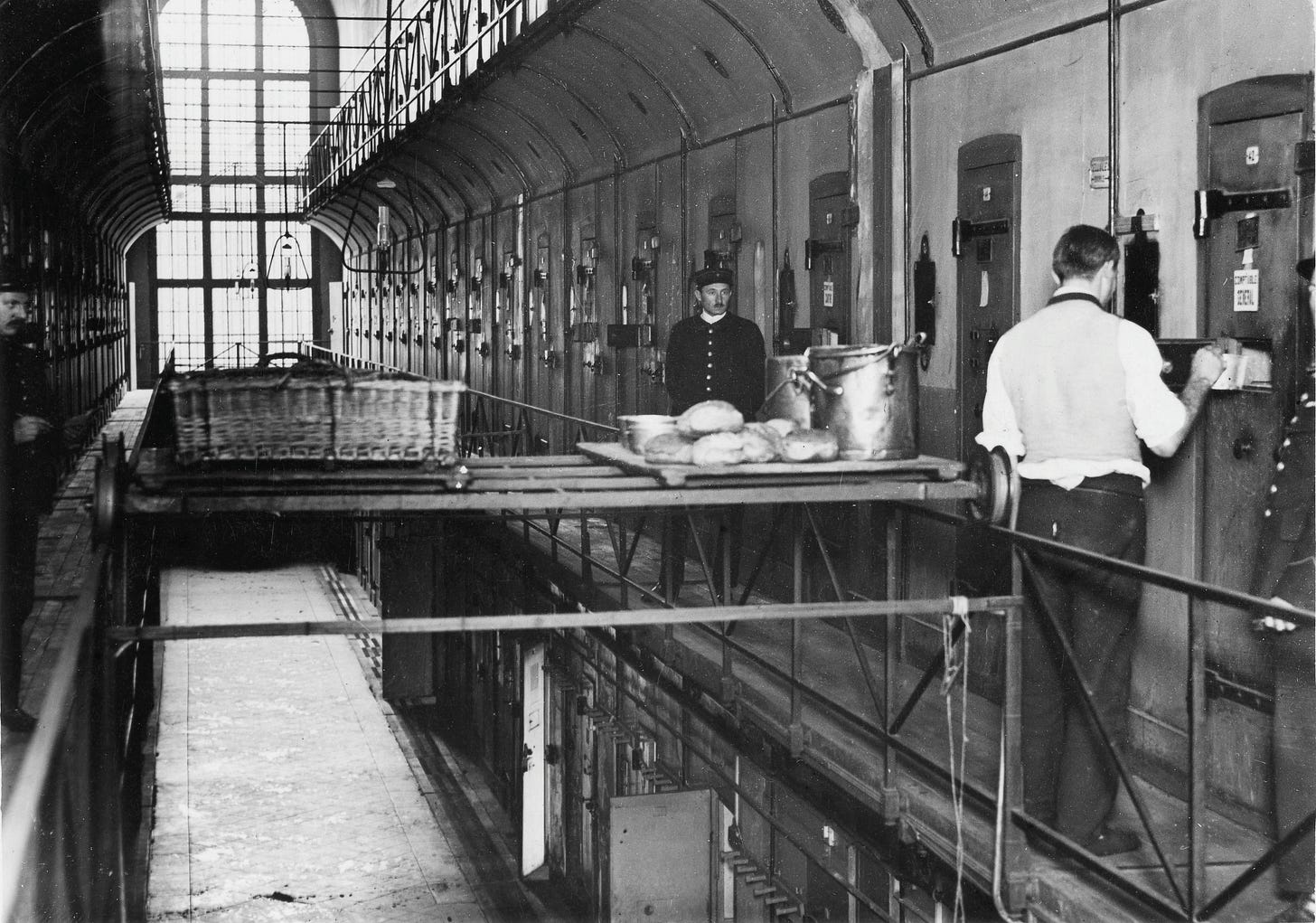
While Macron is embroiled in political death throes, his illustrious predecessor Nicolas Sarkozy faces an even more concrete ending: prison. Last Monday, the former president learned he would be locked up on 21 October in Paris’s Prison de la Santé. Like all French prisons, this institution is bursting at the seams (now at 150% capacity), but Sarkozy gets his own 9-square-metre cell in a special wing (see the video below).
It’s a historic moment: Sarkozy becomes the first French president since the Fourth Republic actually to disappear behind bars. His crime? His close associates allowed Gaddafi’s regime to pump millions into his 2007 election campaign secretly. NGOs who joined as civil parties in the trial, like Transparency International and Anticor, spoke of “a historic verdict sanctioning facts of exceptional gravity.”
⚖️ Setting a Good Example
The former president is an inspiration to many. This week, too, it wasn’t difficult to find quite a few politicians who have committed faux pas, such as the former councillor (and brother-in-law of the mayor) from the village of Avignonet-Lauragais. He received a one-year suspended sentence for child pornography on his computer. The mayor is ashamed of her brother-in-law. A former councillor in Anderny stood trial for threats and sexist remarks to police when he had to sober up in a cell. François Bernardini, the mayor of Istres, is set to stand trial in June 2026 on charges of embezzling public funds and conflicts of interest. It’s not the first time Bernardini has faced legal trouble. The mayor of Sérignan-du-Comtat must pay a 500 euro fine for “intentional violence by a person with public authority.” During a council meeting, he grabbed a resident by the shoulders to eject him from the room.
Finally, there’s some legal squabbling in the far-right camp. The bickering between Marion Maréchal and her former friends at Reconquête! seems endless. On 7 October, the MEP was ordered by the court to pay 3,000 euros in legal costs to Éric Zemmour’s party, for which she was still the lead candidate in the 2024 European elections.
Her aunt Marine Le Pen also had a difficult week. The highest administrative court, the Conseil d’État, again rejected the appeal against exclusion from all elections until 2030. Le Pen thus remains ineligible for five years. This means she cannot participate in any election, including the 2027 Presidential election. The politician was sentenced to five years in prison (two with an ankle bracelet) and a fine of 100,000 euros for misuse of European funds. Her hope now rests on an appeal to be heard from mid-January onwards.
A blow for the Rassemblement national, although its leader, MEP Jordan Bardella, is now the country’s most popular politician. But can a 29-year-old without government experience really reach the Élysée?
🔍 What This Means for Europe
The French disease is contagious — or so European partners fear. The suspension of pension reform is more than an internal French matter: it signals to all of Europe that structural reforms have become politically unfeasible in the Union’s second-largest economy.
France has a budget deficit of 5.8% of GDP in 2024, and a national debt of 115,6% of GDP, the third highest in the EUafter Greece and Italy. Except that Greece and Italy have reduced their debts since the euro crisis. France hasn’t. French government spending amounts to 57% of GDP, 7.5 percentage points more than the eurozone average.
Last year, the European Commission placed France under an Excessive Deficit Procedure. Brussels demands that Paris bring the deficit back below 3% by 2029. But with the suspension of pension reform — which was precisely intended to reduce costs — that target is further away than ever.
Rating agency Fitch downgraded French creditworthiness from AA- to A+ last month. French government bond yields have risen to 80 basis points above Germany, as expensive as Italy, the country that for years was the textbook example of budgetary disorder.
📊 The Wider Picture
What’s fascinating — and alarming — about France’s situation is that it may be a preview of what’s coming elsewhere. The country has:
- A fragmented parliament where no coalition can form
- A president whose reforms are politically impossible
- A public that wants Nordic-level services with American-level taxes
- A demographic time bomb (ageing population) meeting a fiscal time bomb (unsustainable debt)
- Political parties on all sides that prefer chaos to compromise
Sound familiar? It should. This isn’t uniquely French — it’s what happens when developed democracies run out of easy options. Germany can’t invest without breaking its debt brake. Britain can’t fund the NHS without raising taxes. Italy can’t reform without triggering a political crisis.
France is simply the canary in the European coal mine. The question isn’t whether France will get its act together. The question is whether France is showing us all our future: a continent where we know what needs to be done but have lost the political capacity to do it.
🎭 The Theatre of Politics
What strikes an outside observer is the sheer theatricality of it all. Lecornu survives by 18 votes — not through brilliant negotiation, but because the Socialists decided not to shoot themselves in the foot. Macron suspends his signature reform — not because he’s changed his mind, but because he has no choice. Le Pen is out (for now) while Sarkozy is in (prison).
It’s rather like watching a Molière play, except the characters are real and the consequences matter. The French have a talent for turning political crisis into political theatre, and then acting surprised when the theatre burns down.
Meanwhile, across Europe, finance ministers watch nervously. Because if France, with its tradition of centralised power, its administrative capacity, its economic weight, cannot implement fundamental fiscal reforms, what hope for anyone else?
🙏🏼 Thank you!
🎼 The paragraph headings are titles of songs that are in the playlist of this newsletter on Spotify. Totally random French music, but a treat for true francaudiophiles!
🎤 Speaking of music to the ears: ten years ago, my colleague Sara Bertilsson and I launched the podcast So French! — your fortnightly dose of Gallic charm, political intrigue and cultural curiosities. For five years, we dissected France’s passions, paradoxes and petits scandales. After a five-year interlude, we’re back on air. Starting 5 November, So French! returns every two weeks with sharp takes and soft power — from Paris to Provence and everything in between.
👉🏽 Subscribe now on Spotify, Apple Podcasts, or wherever you get your weekly dose of liberté, égalité … and a touch of irony.
🇳🇱 Er is ook een Nederlandse versie van deze nieuwsbrief, klik hier!