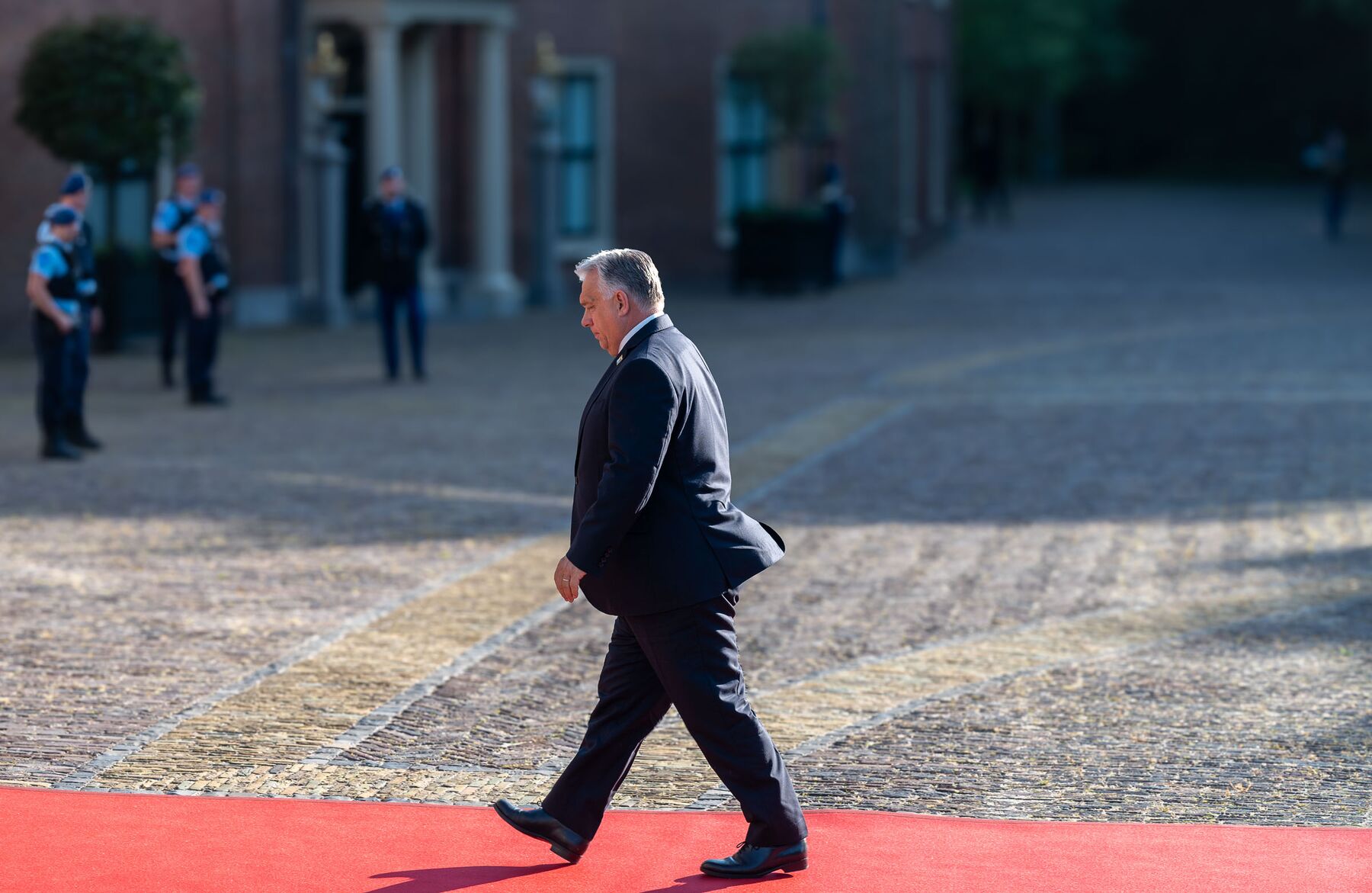

Prime Minister Viktor Orbán welcomed his fellow heads of government to a brand-new stadium. The Prime Minister, a thorn in Europe’s side for years, wanted to show, for a moment, that he mattered. The avenues had been swept, and the police officers’ shoes polished. The colossal parliament building was reflected in the river in the autumn sun, like a mirage of democracy. Once inside, the guided tour proceeded according to Soviet protocol. We marched in tight formation, listened carefully to the guide and, above all, did not stray from the route.
In the centre of the complex, beneath the high dome, lay the wonder of the Hungarian nation: the crown of the country’s first king and patron saint, Stephen (975–1038). Two pimply-faced soldiers paced round the display case housing the treasure. This is an essential part of the myth of the Hungarian nation-state. Photography is forbidden. Steal the crown and the country will collapse. The implicit message, this coming Sunday, is the same: if Orbán loses, the country’s demise is inevitable.
No saviour
The fact that Viktor Orbán might actually lose these elections is, in itself, something of a minor miracle. After sixteen years in power, the illiberal leader has, amongst other things, brought the press, the judiciary, the Ministry of Justice and even the constitution to heel.
With a shrewd campaign – focusing on the fight against corruption and the deplorable state of hospitals and schools – opposition leader Péter Magyar now threatens to throw a spanner in the works for the autocrat. His party, Tisza, looks set to secure 49 per cent of the vote on Sunday. Orbán’s Fidesz remains stuck at just over 40 per cent in the polls.
So much for the good news. But before we raise a glass, it is time for a dose of reality: Magyar is no saviour. To begin with, Péter Magyar himself was a member of Fidesz for many years. This right-wing conservative politician only turned against the party following his divorce from Fidesz leader Judit Varga, who served for many years as Minister of Justice in Orbán’s government.
Democracy has been reduced to a choice between the conservative right and the anti-democratic far-right
As opposition leader, Magyar has emerged as the accuser of Orbán’s corruption. He is polling well among young people and city dwellers, but it remains to be seen what will remain of his popularity after the elections.
Budapest is regarded as a progressive stronghold in a conservative country. To stand a reasonable chance of finally getting rid of Orbán after sixteen years, the main opposition parties are joining forces. Rather than making their own bid for the premiership, a large section of the opposition has rallied behind Magyar. Hungary’s democracy has thus been reduced to a choice between a conservative right-wing prime ministerial candidate and an anti-democratic far-right conservative prime minister.
Moreover, it remains to be seen whether Magyar will immediately repair the strained relationship with Europe. He is no unconditional ally of Ukraine, and certainly no executor of Brussels’ wishes. Indeed, Tisza also voted in the European Parliament against the 90-billion-euro loan to Ukraine, which Orbán has now been blocking for months. Magyar has promised a referendum on Ukraine’s EU membership. Like Orbán, he is opposed to supplying weapons to the neighbouring country.
After the elections, it will become clear just how deeply held Magyar’s Eurosceptic sentiments are. In his campaign, he seems above all to be avoiding issues that might put off former Fidesz voters.
If he wins
But even if Magyar wins the election and wishes to fulfil his promise to make a radical break with his predecessor’s anti-democratic course, he will discover just how complex it is to restore a democracy that has fallen into disrepair.
Hungary’s president, who is loyal to Orbán, has legal means to delay the formation of a government
Over the past sixteen years, Orbán has left behind a network of loyalists in every corner of public life: the Constitutional Court, the Supreme Court, the public broadcaster, the Fiscal Council. Magyar needs a two-thirds majority for constitutional reform. That seems an unrealistically high hurdle. With a simple majority, far-reaching reforms are virtually impossible. Moreover, Hungary’s president, who is loyal to Orbán, has the legal means to delay the formation of a government.
Sixteen years of autocratic rule cannot be undone in a single election night. But even if it were to succeed – if Magyar were to win the elections, and if the handover of power were to go smoothly – If Hungary returns to something resembling a functioning rule of law. Even then, the real question remains unanswered: can Europe finally stand up to Russia and America, now that it is no longer hampered by a Hungarian prime minister who constantly throws a spanner in the works?
The flaw in the system
Orbán has been punching above his weight in Europe for years. As prime minister of a country with a population of just ten million, the Hungarian leader has for years managed to block decisions supported by a large majority of the European population. Time and again, Orbán has demonstrated that the Treaty of Lisbon – the EU’s roadmap – is no match for troublemakers within its own ranks.
As long as EU decisions require unanimity, a single individual can hold the entire Union to ransom. Orbán has masterfully exploited that system: he used his veto to weaken sanctions against Russia, block support for Ukraine and slow down progress towards Ukrainian EU membership.
Viktor Orbán’s Hungary has emerged as an ally that actively lobbies on behalf of the enemy.
He did so with the nonchalance of someone who knows the system protects him. Hungary still refuses to scale back its Russian energy imports and openly propagates pro-Russian views on the war. Meanwhile, it has emerged that the Hungarian Foreign Minister passed sensitive information to the Kremlin.
pullquote: Viktor Orbán’s Hungary has turned out to be the ally that actively lobbies on behalf of the enemy. In a normal military alliance, that would have a name position: right
The European Union theoretically has a bureaucratic ‘nuclear option’ to neutralise an internal saboteur: Article 7.2 of the Treaty on European Union. This stipulates that a Member State may lose its voting rights. In practice, however, this requires the support of all the other twenty-six Member States. But as long as there is also a pro-Russian prime minister in Bratislava, this is a farce.
The fundamental problem is that, almost seventy years after the Treaty of Rome, the European Union still thinks in terms of nation states, with the logic of national sovereignty as its foundation. At the time, each Member State was granted a veto as a guarantee that no one could be outvoted on matters of vital importance. That was a political compromise that made peace possible after 1945. In 2026, it is a hostage clause. Orbán has exposed this flaw with legal precision.
Monument
At the exit of the Hungarian Parliament hangs a sign asking visitors to leave a review on TripAdvisor. Thousands of tourists have given this attraction an average rating of four point six stars. ‘Fantastic atmosphere’, ‘A magnificent monument’, ‘Lots of gold, but that’s fitting. The dome alone is worth the trip.’
Democracy is perfectly admirable as a tourist attraction, regardless of whether it actually functions.
That is another reason why we cannot simply sit back and relax after Sunday if Orbán loses. His premiership was more than just a Hungarian exception; it was a European warning. The architects of the European edifice did not anticipate saboteurs from within. If Europe is not prepared to mend its own flaws, the Union will end up just like the parliament on the Danube: an impressive setting, carefully maintained, but ultimately nothing more than a monument to what was once a vibrant democracy.