What are we actually defending?
💣 When European leaders argue about defence spending, whether it should be three point five per cent of GDP or four or five, the conversation stays almost entirely on capability: aircraft, missiles, satellite systems, the willingness to deter. Rarely does anyone ask the prior question: What, precisely, is all this hardware meant to protect?
🎼🎨 Last week, I found my answer twice over. First in Amsterdam, at the Rijksmuseum’s beautiful Metamorfosen exhibition, where the walls traced Ovid’s Metamorphoses across centuries of European art that has shaped the European spirit. One girl kept whispering until the snakes started moving, then even she stopped mid-sentence in front of a giant video projection of Medusa and the snakes. The following day, in Naarden, a Unesco-listed fortress town east of Amsterdam, in a fifteenth-century church, for the Matthäus Passion. Naarden’s ramparts were built to repel enemies who are long since allies. The church was full, though I guess almost no one there would describe themselves as religious. Three centuries after Bach completed the score in Leipzig, the bass line moved through the stone, and the hall went very still.
MY VIEW: A fortress and a church: both originally built for defence, one military and one spiritual, both now serving something more durable than either. Think of the most intimate moments in any human life like a wedding or a funeral. What do we bring to those rooms? Not a PowerPoint presentation, nor a flag or a weapons system. A song. A poem. A few lines read aloud. Art and culture are not decorations around the edges of political life. European governments spend roughly one per cent of public expenditure on culture, yet the cultural and creative sectors account for an estimated 5.3 per cent of European GDP — more than the defence spending targets now dominating every summit. What seems to bind Europeans across borders and centuries is not territory or sovereignty, but the stories, images, music and ideas that can circulate freely. That freedom is what the percentages are actually for. The percentages are not the point. What matters is what they protect.
Trojan horse with a Hungarian passport
🇭🇺🎠 Next Sunday, 12 April, Hungarians will vote in what may be the most consequential election since the end of Communism. Independent polls consistently placePéter Magyar’s Tisza party eight points clear of Fidesz. Hungary’s electoral system was gerrymandered after 2010 to favour the largest rural party, meaning Tisza may need to outperform by six points or more just to win a majority.
The final week is already following a familiar script. Yesterday, Serbian President Aleksandar Vučić announced that explosives had been found near the Hungarian border; Orbán convened an emergency Defence Council. Magyar called it a staged false flag, a scenario that Hungarian Russia analyst András Rácz had mapped out days before it happened. Tomorrow, JD Vance arrives in Budapest to celebrate the “rich partnership”between Washington and Orbán, just a few days before polling day. The American vice president, on taxpayer funds, effectively campaigning for a sitting prime minister inside a European Union member state. If Orbán loses on Sunday, Washington will have backed the wrong horse. Loudly, expensively, and in full view of the rest of Europe.
MY VIEW: Peter Magyar’s victory would be a relief for the other 26 EU capitals. It would not be a solution. What Hungary has demonstrated over sixteen years is that the EU can be structurally undermined from the inside, and that the Treaties offer almost no effective remedy once a member state is on board. That is not a failure of political will. It is a design flaw. It demands not better enforcement of existing rules but a different union, one capable of protecting itself from within. Magyar is not a saviour. He is, at best, a correction.
The Easter Bunny choked on his own eggs
🐣 On Easter morning, at 8 a.m., the President of the United States posted a rather elegant message on his propaganda platform, threatening to strike Iranian power plants and bridges, ending with the words "Praise be to Allah". Oil prices rose further. This is the leader in whose alliance European security has been anchored since 1949.
MY VIEW: This is, by now, a data point in a long series. What remains remarkable is how muted the reaction in European capitals continues to be. After more than a year of systematic bullying on trade, on NATO, on Ukraine, on Greenland, the collective European response still defaults to statements of concern and calls for dialogue. National reflexes, bilateral dependencies and political caution prevent what the moment actually requires: a clear, joint European declaration that the old relationship has changed and that Europe will act accordingly. The music may still play in the old churches. The point is not to preserve, but to point forward. That is what culture does: it carries meaning across time, and sets direction.
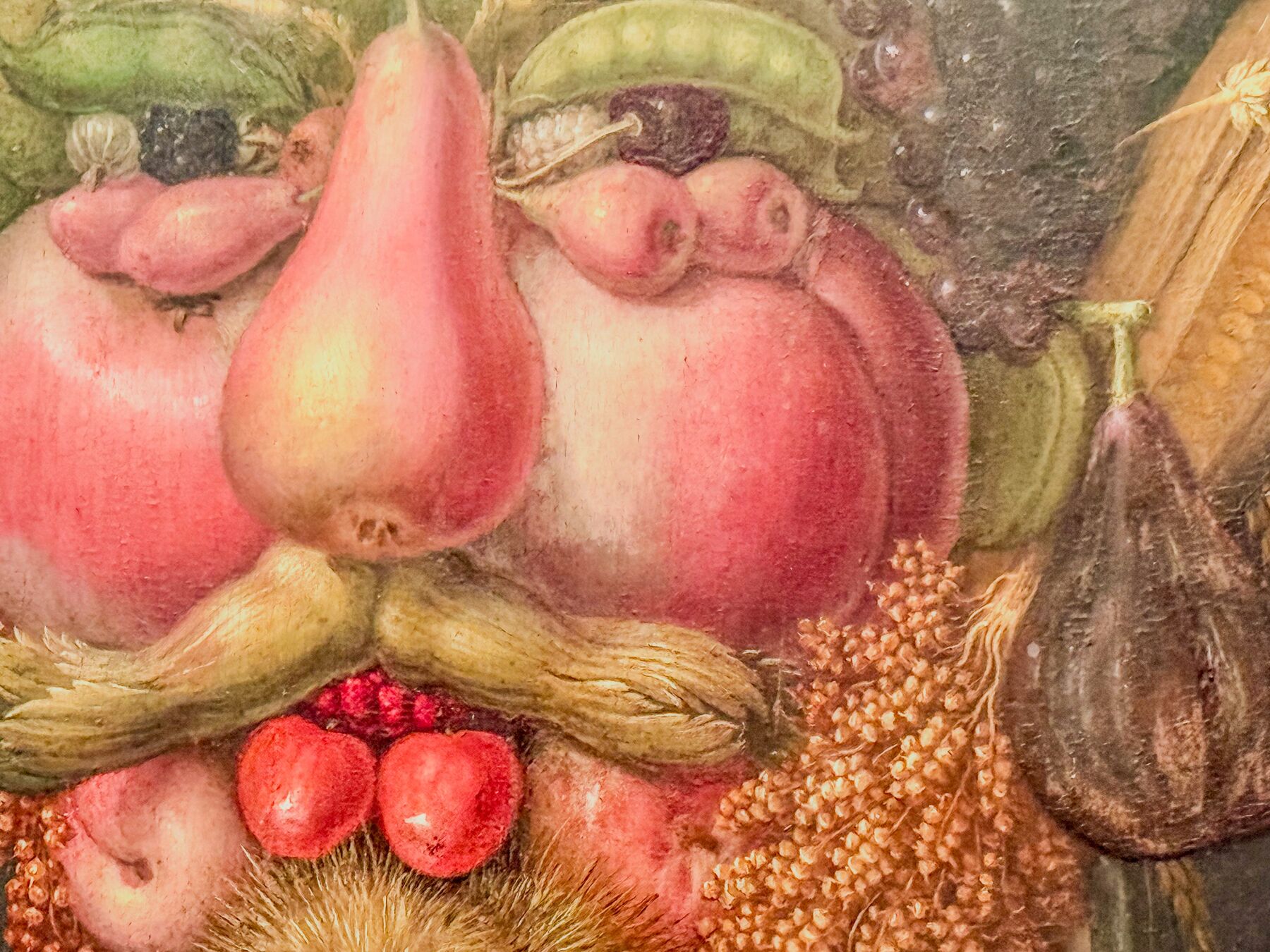
Europe’s politics, by contrast, is still reading from last decade’s score, even as the composition has already changed. Some of today’s ‘leaders’ do not feel like statesmen at all but more like something hastily rearranged, like Arcimboldo’s work: all vegetables, but somehow still a face.
Looking ahead…
Hungary votes on Sunday, 12 April, in what may be the most consequential European election of the year. European finance ministers meet in Warsaw on Thursday to discuss defence spending frameworks. The Iran ceasefire talks in Muscatmay resume on Wednesday, with European observers present for the first time.
⭐️ European Dispatches is published every Monday around noon (CET). From Amsterdam: Enjoy your week! ☀️