
Anyone who regularly gazes out of a moving train window will puncture the myth of overcrowded Netherlands at least once on every journey. Barely a few minutes beyond Utrecht Centraal, the concrete of the Randstad gives way to meadows dotted with meticulously kept farms and improbably serene cows. This is the Netherlands of postcards, the Netherlands tourists photograph, the Netherlands that helped propel several coalition parties to victory at the last election.
Then you arrive in Ede.
At a station that looks as though it has wandered out of a Scandinavian architecture magazine, you change trains and step into the reality of 2025. Ede is a municipality of 125,000 people on its way to 150,000, a place where residents of the Randstad seek refuge because a terraced house here does not yet require an €800,000 mortgage. It is also where the country’s many crises are mixed in one political punch bowl: nitrogen emissions, housing shortages, grid congestion, education and agriculture. Ede is the Netherlands in miniature.
Tanks and tame sheep
The Ginkelse Heide stretches out like a weathered carpet, threaded with purple and yellow. Yet the yellow patches are no impressionist brushstrokes. They are open wounds.
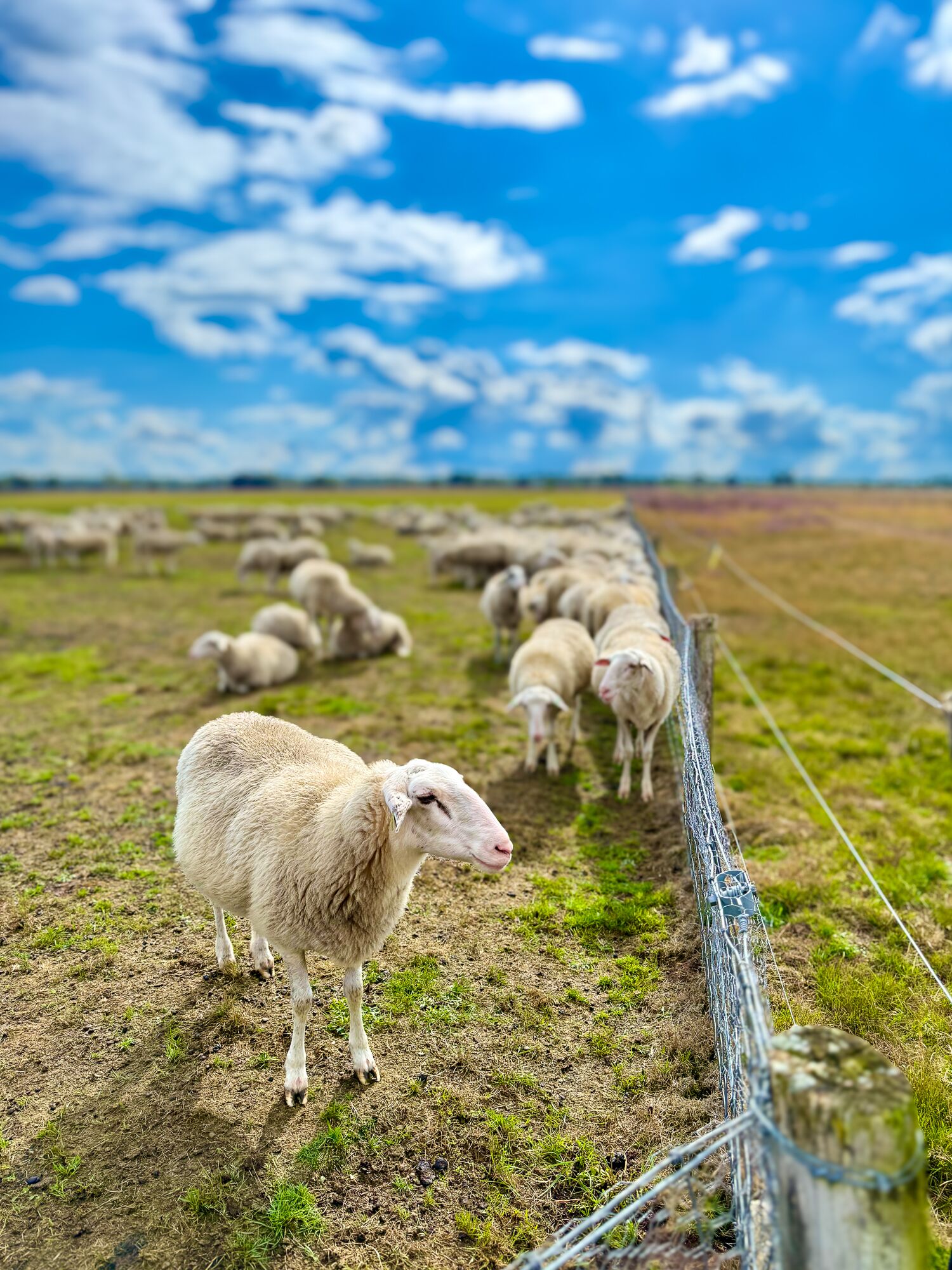
This military training ground, open to walkers and cyclists from sunrise to sunset, bears the indelible marks of its double identity. Deep grooves left by armoured vehicles contain the tracks of deer, wild boar and birds. Look carefully among the rabbit holes and the glossy, well-fed dung beetles, and you will also find traces of wolves, another species capable of dividing Dutch politics. Last year, a shepherd rescued one of his sheep from an attack here. Today, the flock grazes quietly behind a fence, as though the incident had never happened.
‘You can see the effect of the brambles. They are taking over everything,’ says Sam Elfvering, the 28-year-old leader of D66 in Ede, who suggested meeting here. ‘They thrive in acidic soil.’
With some 600 so-called peak emitters, Ede has more major nitrogen polluters than any other municipality in the Netherlands. It is a bleak distinction for a place keen to present itself as sustainable and green. The heath still flowers, although less lavishly than it once did. ‘There is less of it every year,’ says Elfvering. ‘As nitrogen makes the soil more acidic, the heath becomes less and less purple.’
‘Free access, provided you cause no damage,’ warns a Ministry of Defence sign at the entrance. It is a curious instruction in a landscape where much of the damage is already close to irreversible.
On the horizon, lorries thunder along the A12 motorway. At the edge of the heath sit holiday cabins with immaculate gardens, large cars parked outside suggesting a comfortable existence. Behind the windows, the familiar sight of somebody hunched over a telephone.
The heath creates the illusion of wilderness, yet in the Netherlands people are never far away. It is also an unusually precise metaphor for what is going wrong. The beauty disappears gradually, while those in The Hague appear to miss it. Or they notice, wave their arms about energetically and then carry on as before.
Local frustration
‘I have caught myself doing it,’ admits mayor René Verhulst, with the candour of someone who has spent more than 30 years in local government. ‘When certain ministers appear on television talk shows, I switch channels, even when they are talking about housing. Or Ukraine, or whatever else. You simply see nothing happening in practice.’
Verhulst, a Christian Democrat, has spent eight years running the municipality from its 1970s town hall, an exercise in brutalist concrete that might politely be called functionally ugly. The 65-year-old administrator has the expression of a man who has heard too many promises and seen too few results. On his desk sits a tin of Zeeuwse babbelaars, the traditional sweets of Zeeland and a nostalgic reminder of his roots. His story, however, concerns the future, or rather the absence of one offered by The Hague.
‘We now have more than €100m in the bank,’ he says, frustration audible in every word. ‘It is all intended for infrastructure, housing, agriculture, nature and cycle lanes. Everything that needs to be built. Yet the money is doing nothing. It is literally sitting in the bank, waiting for more nitrogen capacity.’
The situation could have come straight from Kafka: a municipality with money, plans and public support, prevented from acting because the rules are unclear or the national framework does not exist. ‘I would rather have a framework I disagree with, because at least you know where you stand,’ says Verhulst. ‘Then you can say: right, we cannot build 1,000 homes, so we will build 400. That is preferable to having no framework at all and remaining in uncertainty.’
The cynical thought presents itself that the Schoof government may have been the perfect administration for a country enamoured of inertia.
‘When the government took office last July, I was optimistic,’ Verhulst says. A year later, his judgement is unsparing. ‘They have done a phenomenal job. To ruin it so completely within a year is genuinely phenomenal. How anyone manages that, I do not know. Well, actually, I do. It was built into the coalition from the start.’ Verhulst’s account raises the question of how the Netherlands became trapped in this impasse. Ede provides the answer in miniature: a municipality with all the ingredients for progress, paralysed by the complexity in which the country has entangled itself.
‘There is nobody setting a direction,’ he says. ‘There is a lot of fine language about breakthrough sites and housebuilding. It gets you absolutely nowhere.’
A few hundred metres from Verhulst’s office, an egg vending machine stands beside the Provincialeweg. Ede’s 3.5 million chickens need somewhere to send their output. The scene has a faintly surreal quality. ‘National politicians are very good at identifying a problem,’ says Verhulst. ‘They are much less adept at solving it. Populists benefit from the problem remaining in place, because once it is solved, their own purpose disappears.’
The observation stings because of its accuracy.
Verhulst has spoken to several ministers in the outgoing government. ‘You sit around the table with them and you can have a conversation. I even believe that they take on board what I say. Then comes the transition to implementation. That is where everything grinds to a halt.’ He points to the promised return of lower-tax red diesel for farmers. ‘That pledge may have earned the BBB three seats at the time. Now it is being dropped. In that case, you have misled your own voters.’
A Dutch mirror
Ede is hardly alone. Across the Netherlands, municipalities face the same paradox: popular with residents, constrained by government. Houten, once conceived as the ideal new town, cannot expand because of nitrogen rules affecting nearby protected areas. In the former Wageningen-Ede-Rhenen-Veenendaal region, once designated as a growth hub for the knowledge economy, every national bottleneck converges. Innovative business parks sit beside farms that may have to close, while thousands of people wait for a home. The Arnhem-Nijmegen region faces a similar predicament.
These municipalities all share the same story. They have money, plans and political will, yet run into an impenetrable web of national rules. The consequences of political fumbling in The Hague land on the desks of these clusterfuck municipalities.
Where national government fails, Ede offers evidence that governing remains possible. The municipality developed its own nitrogen plan, organised what it called a ‘solutions conference’, a phrase The Hague might consider borrowing, and managed to bring together groups that elsewhere spend their time tearing strips off one another. ‘On issues that create huge amounts of noise in The Hague, such as asylum, we are fairly calm here,’ says Elfvering. ‘The latest asylum centre was approved almost unanimously. That would be unthinkable in The Hague.’ Pragmatism takes precedence. ‘Where everything blows up in national politics, we try to find a connection,’ he says.
He points to the local Pride event. ‘We try to organise it in a way that allows the SGP to say: we also want the best for the people in our churches.’ The mayor calls this the ‘Ede way’. ‘You have to do it together: council, executive and civil service. We listen to one another’s answers, we discuss the issues and, when we cannot reach agreement, we vote. However intense it becomes, we do not hold grudges.’
The practical expression of this philosophy was visible during the final council meeting before the summer recess.
‘We had a debate about a solar park that continued deep into the night,’ Verhulst recalls. ‘At half past two, I went over to a few people and said: do come to the barbecue tomorrow. The next day, everybody was there, cheerfully talking to one another again.’
Growing pains
Ede is expanding rapidly. It has grown from what Verhulst nostalgically calls ‘a little heathland village’ into a city with more inhabitants than Maastricht.
Growth has brought prosperity. Ede scores highly for social cohesion, unemployment is ‘unbelievably low’ and homes are in great demand. Success has brought soaring prices and waiting times for social housing of up to four years.
Beside Ede-Wageningen station, the World Food Center is dominated by a giant dome. Once used by the military, the building now carries the question: ‘How will we feed 10 billion people in 2050?’
It is a noble ambition. First, Ede has to house its own growing population.
‘The CPB published figures last week showing how sharply house prices are rising,’ says Elfvering. ‘Here they rose by 14.5 per cent. That puts us at the very top end among Dutch municipalities.’
For a place 45 minutes from Amsterdam, with two intercity stations and nature on its doorstep, the appeal is easy to understand.
‘It is a suburb of Amsterdam,’ Elfvering says matter-of-factly.
‘Because there are simply too few homes, the number of homeless people rises every year,’ he continues.
Homelessness feels particularly jarring in Ede. In a town with a church on almost every corner, one might expect a little more mercy. People even sleep in the underpass beneath the town hall.
‘We cannot find anywhere to establish a permanent shelter. The numbers keep rising,’ says Verhulst.
These social pressures have been compounded by years of cuts to youth care, a service in particularly high demand in Ede. The municipality has a relatively large population of children and teenagers with mental-health difficulties, carrying what is euphemistically called ‘a backpack’: troubled homes, trauma and developmental disorders.
‘We are in the ravine year,’ says Verhulst, referring to the structural funding gap confronting municipalities. ‘There is far too little money for essential services such as youth care.’
The same story is unfolding across the Netherlands. In Ede it feels especially stark, because its effects are visible on the streets of a municipality that places a high value on traditional ideas of care and community.
Ede also has an electricity grid operating at full capacity. Companies want to invest, yet cannot obtain a connection.
‘When you build a residential district, you ideally want to move away from gas,’ says Elfvering. ‘Yet you cannot give people electric heat pumps because they require too much power. You cannot always install solar panels either, because they feed too much electricity back into the grid.’
Grid operator Liander puts it bluntly: ‘The maximum capacity of one or more medium-voltage cables at Ede West substation has been reached for electricity feed-in. Expansion is expected no earlier than the fourth quarter of 2027.’
Across almost the whole province of Gelderland, capacity has run out. New companies cannot establish themselves, housing developments wait for connections and solar panels sometimes have to be disconnected. The future is being held up by the thickness of a cable.
Minister Verhulst?
With his direct manner and practical instincts, Verhulst appears to be precisely the sort of administrator The Hague could use.
Has he ever harboured ambitions for national politics? He shakes his head decisively.
‘I like it here. There are, of course, problems that can only be solved from The Hague.’
He explains why he chose local government.
‘I have always said that you should be able to see the consequences of your own actions. I still know where I planted a tree in Utrecht when I pass it. I remember which community centre I visited. There is nothing I enjoy more than seeing the result of what you have done, every day. I do not think you can achieve that in The Hague. I am not the sort of man who works on grand plans that are never carried out.’
That observation reaches the core of the Dutch predicament. Local politics demands results. National politics rewards the telling of stories.
‘As a municipality, it helps to have friends in the cabinet, former aldermen, for instance. At least they understand what drives local authorities. That is a major difference from many current ministers, who have never served in municipal politics.’
Verhulst sums up his philosophy in a sentence that deserves to hang above the entrance to every government department.
‘Politics is about the marbles as well as the game. The marbles are the results. In The Hague, far too much attention goes to the game.’
Ede tries to remain focused on what needs to be done.
‘Here, you have to deliver results,’ says Verhulst. ‘You walk down the street and somebody immediately stops you to ask about a school that needs to be built. Then you have to deliver. There is little patience for detours.’
The hope of the realists
For all his frustration, Verhulst remains optimistic. He predicts that a new government formed by the traditional parties will be in place before December.
‘I hear a lot of people saying: “I trusted so-and-so,” and now they admit: “Nothing came of it.” There are many farmers who see no future for their businesses, or who say: “I have to work too hard and the outlook is too uncertain.” They are simply waiting to hear what measure comes next.’
For Verhulst, the answer lies in clarity.
‘Farmers also want to know where they stand. The mechanism is difficult to break. You can explain the facts and then they read a BBB publication saying the opposite. They choose to believe that.’ Ede offers proof that the Netherlands remains governable, even after years of amateurism in The Hague. Governing requires a willingness to set ideology aside and work with other people.
In this municipality at the edge of the Randstad, between purple and yellow heathland, grazing sheep, tank tracks and deer trails, optimism still survives. People here understand that the most effective way to move forward is to begin.
Whether The Hague is listening remains an open question.


